• About UGM
  • About FEB UGM
  • Sintesis Portal
  • Webmail
  • English
    • Indonesia
Universitas Gadjah Mada Universitas Gadjah Mada
Faculty of Economics and Business
Master of Science and Doctoral
  • Home
  • Profile
    • Preface
    • Vision and Mision
    • Cooperation
      • DOUBLE DEGREE MASTER PROGRAM
    • Directors
    • Lectures
    • STAFF
  • Admission & Alumni
    • Admission Master of Science
    • Admission Doctoral Program
  • Double Degree
    • MSc in Accounting
    • MSc In Management
    • MSc In Economics
  • Academic
    • Curriculum Master of Science
    • Curriculum Doctoral Program
  • Research
  • Learning
    • Workshops
    • Books
    • REPESEA ERASMUS +
    • Reach Program
  • Home
  • News

Guest Lecture “Changes in Economic Stability Policy: Post the 1997/1998 Economic Crisis”

  • News
  • 29 March 2019, 15.19
  • By : admin

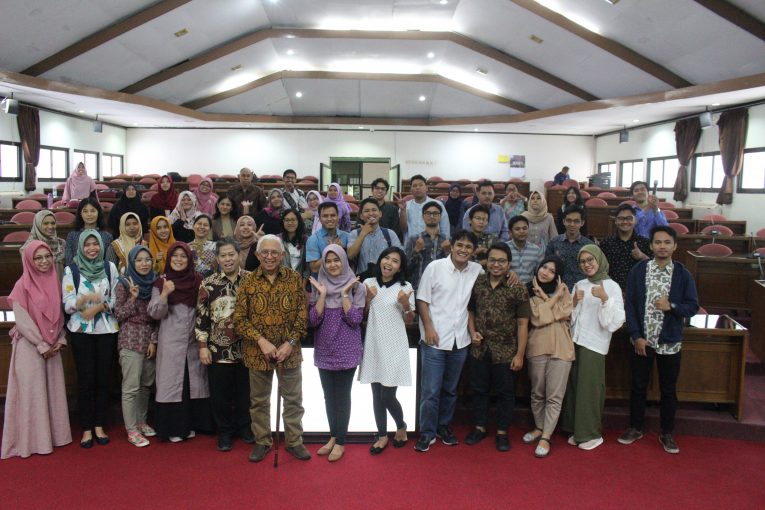
Yogyakarta – Wednesday, March 27 2019, Master of Science and Doctorate Program, Faculty of Economics and Business, Universitas Gadjah Mada held a guest public lecture entitled “Changes in Economic Stability Policy: Post the 1997/1998 Economic Crisis.” The guest lecture on this occasion was presented by Prof. Dr. Anwar Nasution, and moderated by Prof. Dr. Catur Sugiyanto, M.A. The event was held at the BRI Auditorium, 3rd Floor, MD FEB UGM Building, and was attended by students of the MD FEB UGM Program.

Prof. Anwar Nasution explained the development of monetary policy since the 1988 Crisis until now. In the New Order era, how much monetary policy was under government control. The rupiah exchange rate is tightly managed. Interest rates on loans and repair deposits are also under the control of the government. Many credit programs are channelled by the government through the banking sector so that economic stability becomes more secure. Bank Indonesia is a government bank that meets the government’s financial needs. If government revenues do not meet the target, the government submits a loan to Bank Indonesia. Government loans to Bank Indonesia are carried out by printing new money.

The stability policy then shifted into the banking sector deregulation policy. Interest rates are left to the market mechanism, and the exchange rate is released, as well as foreign debt by the private sector.

Indonesia’s economic growth was driven by the deregulation policy. However, it saves destructive power. First, export growth and foreign debt make the exchange rate more openly following market movements. Second, short-term foreign debt is often used for long-term investments. Finally, a lot of infrastructure development involves Suharto’s cronies, so many feasibility studies are sacrificed. The fragility of the economic structure resulted in the inability to handle the 1998 Monetary crisis.

The era of reform, through the direction of the IMF, the government embraced deregulation. Two things are underlined in this era, namely decentralization/regional autonomy and the establishment of the Financial Services Authority. The reform era was also marked by global macro conditions that lacked conditions that negatively impacted economic growth. For students, policy development is interesting because Macro theories such as Taylor’s rule, Phillips curve, Okun’s Law and others are more relevant to the Indonesian economy.

At the end of this guest lecture, Prof. Anwar Nasution underscored the destructive power because of the construction of infrastructure that has the character of building lighthouses in the Jokowi era such as the Jakarta-Bandung fast train. (CTS)
Post Views: 145

Related Posts

MD Field Study – Desa Wisata Nglanggeran

News Friday, 26 June 2026

On Saturday, June 20, 2026, the Master of Science and Doctoral (MD) Program at the Faculty of Economics and Business, Gadjah Mada University (FEB UGM) conducted a field study in Nglanggeran Tourism Village.

Seminar on ASEAN Regional Economic Outlook and Fiscal Policy: Navigating Global Uncertainty, Sustaining Growth and Stability in ASEAN

News Thursday, 25 June 2026

On Tuesday, May 26, 2026, Department of Economics and Master of Science and Doctoral Program (MD) of the Faculty of Economics and Business, Universitas Gadjah Mada (FEB UGM), in collaboration with the ASEAN+3 Macroeconomic Research […].

The Master of Science in Economics Program, Faculty of Economics and Business, Universitas Gadjah Mada, Holds End-of-Program Evaluation for International Exchange Students

BookNews Monday, 22 June 2026

On Thursday, June 18, 2026, the Master of Science and Doctoral Program (MD) of the Faculty of Economics and Business, specifically the Master of Science in Economics Program, held a program evaluation and farewell session […].

Guest Lecture “Experimental Research Design”

News Monday, 25 May 2026

On Tuesday, May 19 2026, the Master of Science and Doctoral Program (MD) of the Faculty of Economics and Business Universitas Gadjah Mada (FEB UGM) organized a guest lecture entitled “Workshop Research Method” featuring Dr. […].

Recent Posts

  • MD Field Study – Desa Wisata Nglanggeran
    26 June 2026
  • Seminar on ASEAN Regional Economic Outlook and Fiscal Policy: Navigating Global Uncertainty, Sustaining Growth and Stability in ASEAN
    25 June 2026
  • The Master of Science in Economics Program, Faculty of Economics and Business, Universitas Gadjah Mada, Holds End-of-Program Evaluation for International Exchange Students
    22 June 2026
  • Guest Lecture “Experimental Research Design”
    25 May 2026
  • “Guest Lecture – Hidden Visual Signals in Digital Advertising through Machine Learning and Consumer Response”
    25 May 2026
Universitas Gadjah Mada

Universitas Gadjah Mada
Faculty of Economics and Business
Master of Science and Doctoral Study Program
Jln. Nusantara, Bulaksumur, Yogyakarta. Indonesia 55281
+62 (274) 580726, 524607-609
+62 (274) 524606
pascaeko@ugm.ac.id

Hotline

    +62 8175464545

Social Media

© 2026 Faculty of Economics and Business UGM

WhatsApp
HiHello 👋, welcome to Master of Science and Doctor - Faculty of Economics and Business UGM
Need Help?
Open Chat
Powered by Joinchat