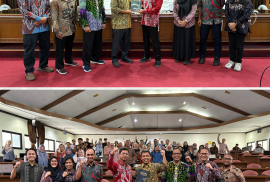
Yogyakarta, November 11, 2026 – The Master of Science and Doctoral Program (MD) at the Faculty of Economics and Business, Universitas Gadjah Mada (FEB UGM), held a seminar titled “Higher Education Expansion in Indonesia: Trends, Drivers, and Labour Market Returns” on Wednesday (November 11). The seminar took place from 09.00 to 11.00 WIB at the BRI Auditorium, 3rd Floor of the MD FEB UGM Building, and was open to FEB UGM students. It featured Dr. Xue (Sarah) Dong from the Crawford School of Public Policy, Australian National University (ANU), Australia, as the speaker. Qisha Quarina, Ph.D., Assistant Professor of Economics at FEB UGM, served as moderator. In her presentation, Dr. Sarah Dong shared the findings of a study she conducted with Tan Jenar and Javier Prisadi of Indonesia’s Ministry of Finance. The study was motivated by two phenomena occurring simultaneously in Indonesia: a rapid rise in higher education enrolment and an increasingly tight labour market for university graduates.
The findings show that higher education expansion in Indonesia has been driven mainly by rising living standards and a growing number of higher education institutions, rather than by changes in the wage premium for university graduates. The number of higher education institutions increased by more than 3,000 between 1995 and 2020, while real household per capita expenditure doubled between 2007 and 2019. The wage premium for D4/S1 (bachelor’s degree) graduates rose between 2004 and 2012, then declined. It currently stands at around 35 percent for women and 30 percent for men. The study also found that the establishment of new higher education institutions between 1995 and 2015 tended to reduce men’s employment by around 4 percentage points. In contrast, women’s employment increased by around 5 percentage points.
At the end of her presentation, Dr. Sarah Dong raised several questions for future research. These included how changes in industrial structure and technology, including artificial intelligence, affect the skills that graduates need, and what role the privatisation of the higher education sector has played. She also emphasised the importance of increasing demand for the young skilled workers already available in Indonesia. Through this seminar, the MD FEB UGM Program hopes that students will gain new insights into education and employment issues and be encouraged to pursue research in labour economics.