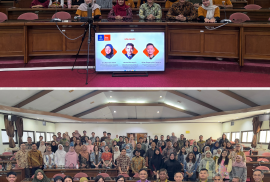
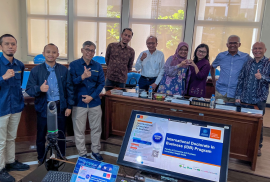
On Friday, July 17, 2026, the Master of Science and Doctoral Program, Faculty of Economics and Business, Universitas Gadjah Mada (UGM), in collaboration with the Aceh Reintegration Agency (BRA), organized a seminar entitled “Peacebuilding on Post-Conflict Aceh: Sustaining Peace After Civil Conflict: Achievements, Implications, and Challenges”. The seminar was held from 09:30 AM to 12:30 PM WIB at the Lippo Room, 2nd Floor, MD FEB UGM Building. The seminar featured three distinguished speakers: Muhammad Ryan Sanjaya, Ph.D. (Lecturer, Department of Economics, FEB UGM), Dr. (Cand.) Jamaluddin, S.H.,M.Kn. (Chairman of the Aceh Reintegration Agency 2026), and Arif Arindita, Ph.D. (Postdoctoral Research Fellow, University of Milano-Bicocca, Italy), with M. Fawdy Renardi Wahyu, M.Sc. (Lecturer, Department of Economics, FEB UGM), serving as the moderator.
The seminar aimed to provide participants with a comprehensive understanding of peacebuilding in post-conflict Aceh, covering the achievements that have been made, the challenges that remain, and their implications for social and economic development. By integrating both academic and practical perspectives, the seminar encouraged participants to recognize that sustaining peace is a long-term process requiring collaboration among multiple stakeholders.
During his presentation, Dr. (Cand.) Jamaluddin discussed the long history of the Aceh conflict, which eventually reached a peaceful resolution through the signing of the Helsinki Memorandum of Understanding (MoU) in 2005 following the devastating 2004 Indian Ocean tsunami. He emphasized that the peace process not only brought an end to armed conflict but also laid the foundation for development while reaffirming Aceh’s position within the framework of the Unitary State of the Republic of Indonesia (NKRI). Nevertheless, he noted that several provisions of the Helsinki MoU, particularly those concerning the reintegration of former combatants, employment opportunities, and the utilization of the Special Autonomy Fund, continue to face implementation challenges.
One of the key topics discussed during the seminar was the importance of education as a long-term investment for sustaining peace. According to the speaker, communities affected by the conflict, particularly the children of former combatants and conflict victims, should be provided with broader access to education through affirmative policies. Education was highlighted as a crucial means of improving human capital while strengthening social stability and promoting sustainable development in Aceh.
The seminar also presented preliminary research findings on the impact of peace on educational attainment and women’s empowerment in Aceh. The findings indicated that the peace process has contributed positively to educational outcomes. Higher educational attainment among women was found to be associated with greater decision-making autonomy, delayed marriage, increased contraceptive use, and a tendency to have fewer children. These findings suggest that the benefits of peace extend beyond security, contributing significantly to improvements in the overall quality of life.
The event concluded with an interactive discussion and question-and-answer session. Participants raised a range of strategic issues, including proposals for educational quotas for the children of former combatants, the evaluation of Aceh’s special autonomy policy, and the relatively low level of women’s economic participation in the post-conflict period. The discussion also emphasized the importance of involving women affected by the conflict in reconciliation efforts and reaffirmed the need for a strong collective commitment to ensuring sustainable peace in Aceh.
Through this seminar, participants gained deeper insights into the dynamics of peacebuilding in Aceh and the challenges that remain in the post-conflict era. The event also reflected the commitment of the Master of Science and Doctoral Program at FEB UGM to fostering academic dialogue, strengthening cross-institutional collaboration, and promoting evidence-based policy discussions in support of inclusive and sustainable development.