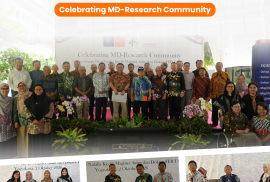
On Saturday, June 20, 2026, the Master of Science and Doctoral (MD) Program at the Faculty of Economics and Business, Gadjah Mada University (FEB UGM) conducted a field study in Nglanggeran Tourism Village. This activity, part of an out-of-class learning program, provided students with the opportunity to directly observe tourism potential management, local product development, and community-based economic activities.
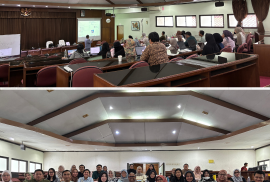
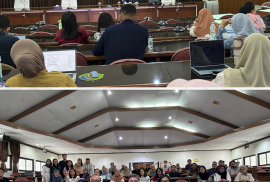
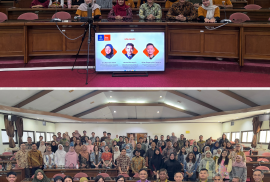
Before visiting the three main locations, the activity began with an educational session on the development and management of Nglanggeran Tourism Village. The session was delivered by Mr. Mursudi, a local resident known for his active involvement in tourism village development. In his presentation, he explained the development of Nglanggeran Tourism Village, the role of the community in managing village potential, and the importance of community participation in supporting sustainable tourism management.
This field study was not only conducted as a visit, but also as a means to connect academic concepts with community practices. Through this activity, students gained an understanding of how natural potential, community creativity, entrepreneurial activities, and tourism management can be developed in an integrated manner to provide economic and social benefits to the local community.
The visit began with an introduction to the management and processing of goat milk. The students received an explanation of the stages of milk processing to produce value-added products. This activity provided an overview of the importance of managing local resources, maintaining product quality, and developing innovations to support the sustainability of community businesses.
Then, continued to the Nglanggeran Reservoir, one of the area’s tourist attractions. Here, the students observed how natural and environmental potential is utilized as part of tourism destination development. The existence of the Nglanggeran Reservoir also demonstrates that destination management requires a link between environmental conservation, visitor experience, and community empowerment.
The students then visited Griya Cokelat Nglanggeran, where the community develops processed chocolate products as a form of creativity and local economic activity. During the visit, the students gained insight into the process of creating value from local commodities through product processing, product variety development, and marketing. Griya Cokelat Nglanggeran serves as an example of how community innovation can increase the economic value of resources available in the surrounding environment.
The educational sessions and visits provided an understanding that village tourism development relies not only on natural attractions but also requires business management, product innovation, community participation, collaboration among local stakeholders, and sustainable resource utilization. These activities also provided an understanding of the importance of collaboration between tourism managers, business actors, and the community in developing economic activities that provide broader benefits.
Togetherness was also a key element of this field study. Interactions between students during the trip and visits provided a space for exchanging views, discussing observations, and strengthening relationships between students and educational staff. Through the field study to Nglanggeran Tourism Village, the MD FEB UGM Study Program continues to strive to provide relevant and contextual learning experiences. This activity is expected to broaden participants’ insights into community-based tourism management, local entrepreneurship development, value creation through product innovation, and the application of sustainability principles in economic activities.