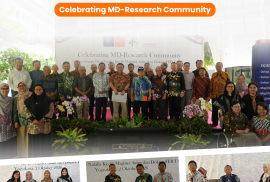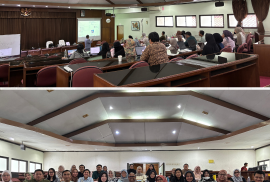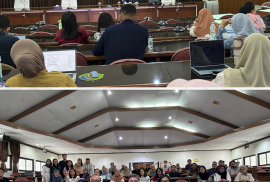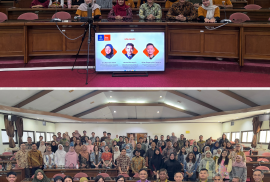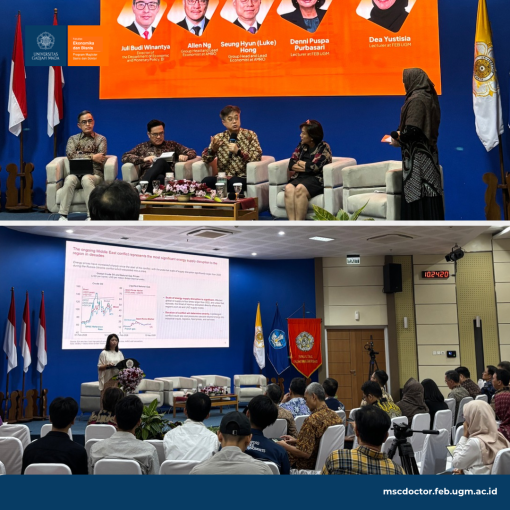
On Tuesday, May 26, 2026, Department of Economics and Master of Science and Doctoral Program (MD) of the Faculty of Economics and Business, Universitas Gadjah Mada (FEB UGM), in collaboration with the ASEAN+3 Macroeconomic Research Office, organized a seminar entitled “Seminar on ASEAN Regional Economic Outlook and Fiscal Policy” with the theme “Navigating Global Uncertainty: Sustaining Growth and Stability in ASEAN.” The event was held offline from 09.30 AM to 01.00 PM WIB at the Function Hall, 8th floor, Learning Center Building, FEB UGM.
The seminar featured Byunghoon Nam, Deputy Group Head and Senior Economist at the ASEAN+3 Macroeconomic Research Office, and Catharine Kho, Senior Economist at the ASEAN+3 Macroeconomic Research Office, as the main speakers. The event also included a panel discussion moderated by Dea Yustisia, lecturer at FEB UGM, with panelists Denni Puspa Purbasari, lecturer at FEB UGM, Juli Budi Winantya, Director of the Department of Economic and Monetary Policy at Bank Indonesia; Allen Ng, Group Head and Lead Economist at the ASEAN+3 Macroeconomic Research Office; and Seung Hyun (Luke) Hong, Group Head and Lead Economist at the ASEAN+3 Macroeconomic Research Office.
In this seminar, the speakers discussed the economic outlook of the ASEAN+3 region based on the ASEAN+3 Regional Economic Outlook 2026 report. The ASEAN+3 region was considered to be entering 2026 from a relatively strong economic position after successfully navigating global economic dynamics in the previous year. Regional growth was supported by solid domestic demand, stronger intra-regional trade, and momentum from the technology sector, including rising demand for semiconductors related to the development of artificial intelligence. However, the speakers also emphasized that the region’s economic outlook still faces various risks, including geopolitical conflict, energy price volatility, uncertainty over international trade tariffs, and the potential slowdown of the global technology cycle.
In addition to discussing the short-term outlook, the seminar also highlighted the importance of long-term economic resilience in the ASEAN+3 region. The speakers emphasized that countries in the region need to strengthen the diversification of energy sources and production inputs, maintain open regional supply chains, and accelerate the transformation toward a growth model driven by productivity, technology, and innovation. In the Indonesian context, economic linkages with ASEAN+3 are an important issue, as a large share of Indonesia’s exports is connected to this region. Therefore, regional integration, domestic value-added improvement, and competitiveness enhancement are strategic aspects in maintaining stability and promoting sustainable growth.
The seminar also addressed fiscal challenges faced by ASEAN+3 countries. During the discussion, the speakers highlighted that fiscal space in several countries has become increasingly limited after the pandemic period, while financing needs for development, social protection, digital transformation, and energy transition continue to rise. Therefore, fiscal policy needs to be directed toward public spending efficiency, stronger revenue mobilization, improved tax administration, and the credibility of medium- and long-term fiscal frameworks. Fiscal sustainability should not only be assessed through the debt-to-gross domestic product ratio, but also by considering institutional quality, fiscal risks, debt composition, and the government’s ability to maintain public trust.
In the panel discussion session, the panelists discussed the economic challenges facing Indonesia and the ASEAN region amid global uncertainty. The discussion highlighted the importance of growth that is not only macroeconomically stable, but also inclusive and widely felt by society. Issues such as income inequality, job opportunities for younger generations, housing affordability, technological disruption, the quality of foreign investment, and regulatory certainty were key concerns. The panelists also emphasized the need to improve the quality of the business climate so that incoming investment can support productivity, create decent jobs, and strengthen national economic competitiveness.
From the perspective of monetary policy and financial system stability, the discussion also highlighted the role of Bank Indonesia in maintaining price stability, the rupiah exchange rate, and financial markets amid various external shocks. Policy coordination among Bank Indonesia, the Ministry of Finance, the Financial Services Authority, and related institutions was considered important to ensure policy synergy without reducing the independence of each institution. Such coordination is needed to manage inflation, maintain financial market stability, support financing for priority sectors, and strengthen long-term economic resilience.
Furthermore, the seminar discussed the importance of ASEAN+3 regional integration in responding to global challenges. Stronger economic integration is expected to enhance regional resilience, but it also requires more intensive policy coordination, particularly in trade, investment, connectivity, payment systems, and fiscal and tax cooperation. Strengthening regional payment systems, such as cross-border quick response code payments and payment links, was also viewed as an important step in supporting the smooth flow of goods and services across the region.
The event was conducted interactively through discussion and question-and-answer sessions involving participants, speakers, and panelists. Various strategic issues were discussed, ranging from the prospects of ASEAN+3 as a center of global growth, Indonesia’s opportunity to become one of the world’s largest economies, the impact of regional integration on fiscal policy, to the challenges of monetary and fiscal policy coordination in maintaining long-term stability. Through this seminar, participants gained a more comprehensive understanding of regional economic dynamics, fiscal challenges, and the importance of regional cooperation in maintaining ASEAN’s growth and stability amid global uncertainty.