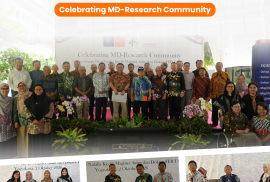
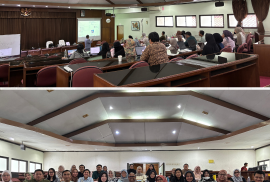
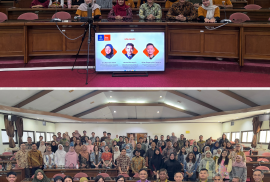
On Wednesday, September 9, 2026, the Master of Science and Doctoral Program (MD) of the Faculty of Economics and Business, Universitas Gadjah Mada (FEB UGM), held an academic session on the topic “Validity and Reliability for Qualitative Research,” featuring Prof. Renato Pereira of ISCTE Business School Lisbon, Portugal as the speaker. The session was held offline from 11:30 a.m.–1:30 p.m. WIB at the BRI Auditorium, 3rd Floor of the Master of Science and Doctoral Building, FEB UGM. During the session, Prof. Renato discussed how the quality of qualitative research should be understood in accordance with the underlying research paradigm and methodological tradition, particularly in assessing credibility, transparency, reflexivity, and the connection between empirical evidence and researchers’ interpretations. He emphasized that the concepts of validity and reliability cannot be mechanically applied in the same way as in quantitative research. Differences in how knowledge and reality are understood require researchers to select quality criteria that are aligned with the research approach they adopt.
Within an interpretivist approach, research quality is reflected more strongly through credibility, transparency of the research process, reflexivity, and the connection between data and researchers’ interpretations. The discussion also highlighted the concept of trustworthiness, encompassing credibility, transferability, dependability, and confirmability, as part of efforts to establish the quality of qualitative research. Prof. Renato explained that aspects such as sample size, triangulation, and member checking should not be used merely as formal procedures to demonstrate that a study has met certain standards. Instead, methodological decisions should be considered in relation to the research objectives, the characteristics of the phenomenon, the research context, and the depth of evidence generated.
Furthermore, Prof. Renato emphasized the importance of transparency and methodological accountability throughout the research process, including documenting changes in research design, analytical procedures, and the researcher’s position in relation to the data. In qualitative research, differences in information across sources do not necessarily indicate errors; rather, they may provide insights into different perspectives, dynamics, and contexts. Therefore, researchers need to ensure that their interpretations are grounded in clear empirical evidence and demonstrate how conclusions are derived from the data. Through this session, students were encouraged to understand that the quality of qualitative research is ultimately determined by methodological coherence, sufficiency of evidence, transparency of the research process, and the strength of the argument, rather than merely by the use of particular procedures.