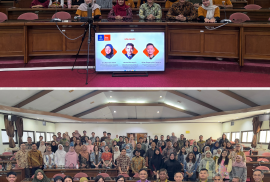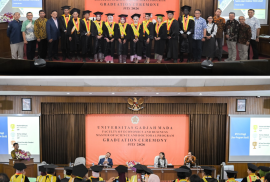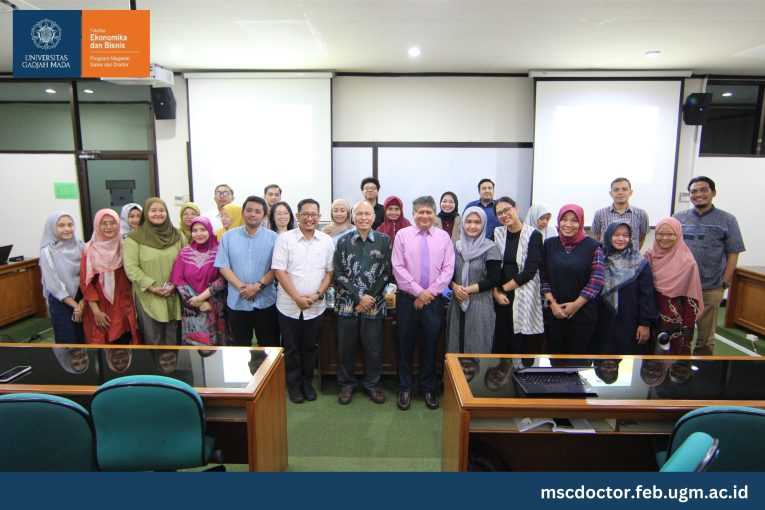
On Thursday, January 18, 2024, the Master of Science and Doctoral Program at FEB UGM organized a general lecture on the topic “Generative Artificial Intelligence’s Effects on the Financial Services Industry,” featuring Prof. Nir Kshetri from the Bryan School of Business and Economics, The University of North Carolina-Greensboro, as the main speaker and moderated by Prof. Mamduh Mahmadah Hanafi, M.B.A., Ph.D., from the Faculty of Economics and Business, UGM. The event took place in a hybrid format, with on-site activities at the BRI Auditorium Lt.3 of the Master of Science and Doctoral Building at FEB UGM and through a ZOOM meeting. The program ran from 09:00 to 12:00 WIB. Participants included master’s and doctoral program students.
During his presentation, Prof. Nir Kshetri explained the impact of GAI on the financial services industry, based on McKinsey’s findings. The adoption of Generative Artificial Intelligence (GAI) could result in an annual additional value of $2.6 trillion to $4.4 trillion for the global economy. According to Accenture’s 2024 trends, GAI offers remarkable advantages for the Financial Service Industry (FSI), with potential operational efficiency improvements of 22-30% and an anticipated revenue increase of 6%. NVIDIA’s State of AI in Financial Services report also stated that 91% of financial services companies are evaluating or implementing AI in their operations. GAI plays various roles in banking and insurance, extending beyond customer service chatbots to include automated financial analysis and code development assisted by GAI.
Prof. Nir also explained the concept of Large Language Models (LLM)/Generative Pre-trained Transformers (GPT), an algorithm trained on a large amount of text-based data. Text-based input is then transformed to create human-like text using deep learning. The data sources include the internet, scientific research, books, and social media posts. Furthermore, he elaborated on the OECD’s definition of artificial intelligence, stating that AI systems are machine-based systems with explicit or implicit goals. They draw conclusions from received inputs to generate outputs such as predictions, content, recommendations, or decisions that can influence the physical or virtual environment. Different AI systems vary in autonomy and adaptability after implementation.
Prof. Nir also discussed the benefits and facilitators of Generative AI in the Financial Services Industry, such as:
Strategic Integration for Sustainable Benefits: Strategic adoption of Generative AI provides sustainable benefits and advantages for the financial services industry, enhancing overall performance by leveraging artificial intelligence.
Precise Insights through Abundant Data: The primary benefit of using GAI is its ability to process and analyze abundant and high-quality customer data. In the context of banking, this allows companies to gain accurate insights into customer behavior, preferences, needs, and risks, facilitating smarter and more targeted decision-making.
Efficiency Improvement Across Functions: Generative AI plays a crucial role in restructuring data silos and improving efficiency across various functions in financial services companies. With its ability to integrate data from various sources, GAI serves as a facilitator for more efficient operations, including legal, engineering, and marketing aspects.
Strengthening Cybersecurity with GAI: Cybersecurity is a top priority in the financial services industry, and GAI provides facilities for predicting and countering cyber threats. Through real-time scenario simulation and anomaly detection, GAI helps companies face cybersecurity challenges with faster and more effective responses.
Innovation through Synthetic Data: Generative AI also drives innovation through emerging technologies, such as the use of synthetic data. Successful examples, like fraud detection by Stripe and insurance underwriting platforms by Cowbell, demonstrate that GAI offers diverse benefits in creating new solutions and enhancing competitiveness in the financial services industry.
In conclusion, Generative AI not only provides a competitive advantage but also serves as a key facilitator in achieving operational efficiency, cybersecurity, and sustainable innovation within the financial services industry.
The activity aimed to sharpen students’ understanding of generative artificial intelligence in the financial services industry. Many new insights were gained from the discussion. After the lecture session, participants actively engaged in a Q&A session, and the event proceeded smoothly. After two hours, the program concluded with a group photo session.